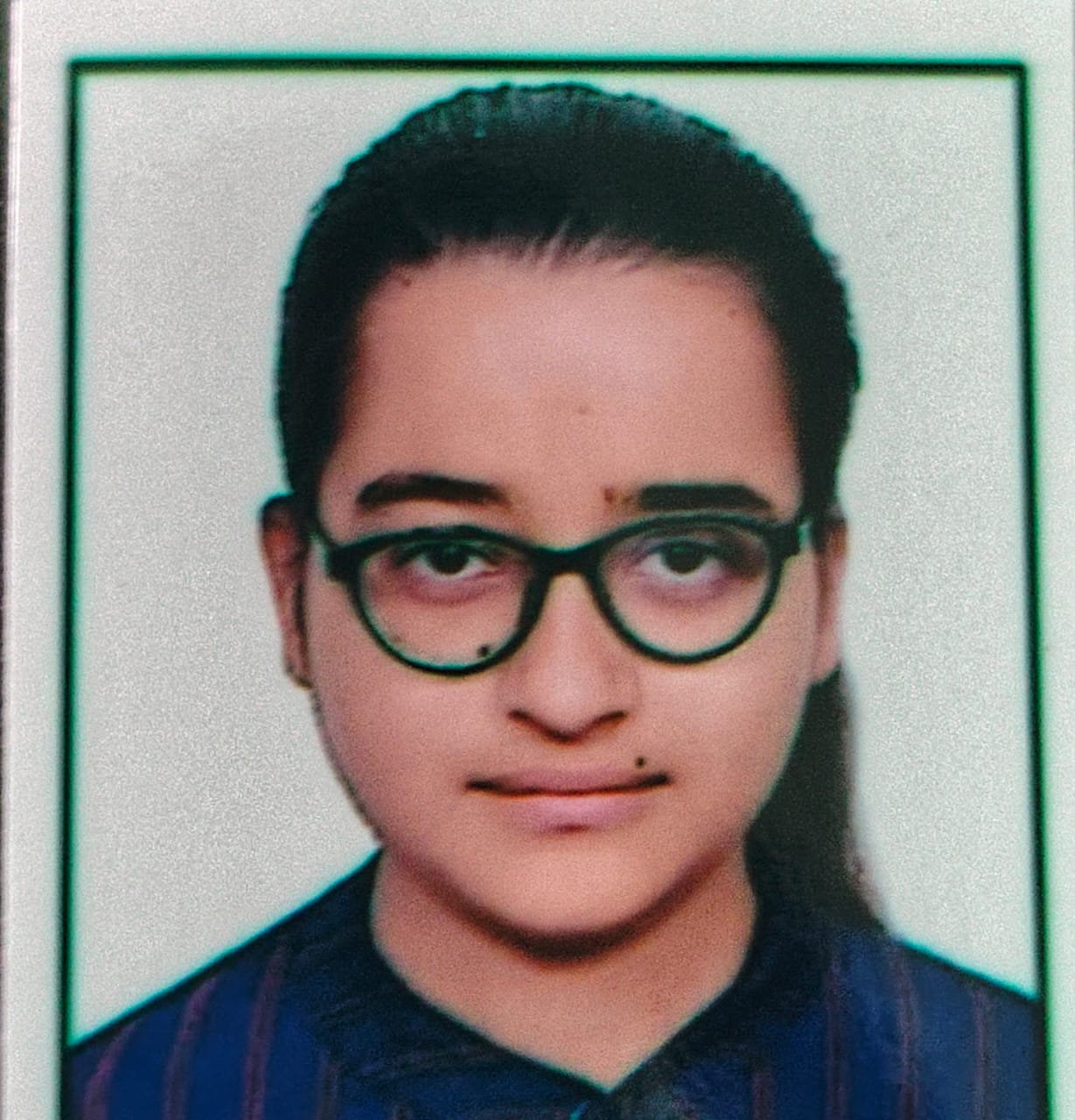
Verified · Woman tutor
Ayushi Yadav
In Aligarh
Aligarh
Teaches Biology
- Classes
- 9–11
- Fee
- ₹400/hr
Tutors who teach from the board’s current syllabus files, matched to your child’s class, group and medium, with close attention to Class 11 physics and maths.
 Guide by NXTutors Academic Team · Subject tutors and editors at NXTutors
Real tutors first; sample profiles are marked. We suggest suitable tutors, and you meet one at a free demo class.
View all tutors →
In Aligarh
Aligarh
Teaches Biology
In Uttar Pradesh
Indirapuram, Ghaziabad
Teaches Maths · Science · English
In Uttar Pradesh
Lucknow
Teaches Physics · JEE
In Uttar Pradesh
Sahibabad & Rajendra Nagar, Ghaziabad
Teaches Hindi
In Uttar Pradesh
Sector 81, Noida
Teaches Maths · Science
In Uttar Pradesh
Sahibabad & Rajendra Nagar, Ghaziabad
Teaches Maths · Physics
In Uttar Pradesh
Sector 49, Noida
Teaches Maths
In Uttar Pradesh
Sector 76, Noida
Teaches Maths · Science · Hindi
Tutors who join go through an ID check. Tell us the class, board and your area: we share two or three matched tutors, each with their fee, and the first class is a free demo, at home or online.
Book a free demo classAcross NXTutors, most home-tuition sessions fall between ₹800 and ₹2,500 an hour; Classes 11–12, IB/IGCSE and JEE/NEET sit toward the upper end; specialists for IB HL or JEE Advanced can charge more. Tutors set their own fee, and you see each tutor's fee before the demo class.
Monthly example: 3 one-hour classes a week ≈ ₹9,600–₹32,500 a month (12–13 classes at ₹800–₹2,500 an hour). An example, not a quote: your tutor's own fee decides the real figure.
See a monthly example and why one-to-one tuition costs more →
NXT AI can make mistakes. Please verify important details. Continue on WhatsApp
For many Aligarh students, the UP Board year that changes things is not Class 10 or Class 12 but Class 11. A student who chose the science group meets a physics course twice the weight of anything in High School, a separate practical exam that has its own pass mark, and a maths paper with no internal marks to cushion it. This page turns the 2026–27 physics and mathematics syllabus files into a plan a home tutor can follow. It also explains which board office serves Aligarh, how the board's Hindi documents should be used, how tutors reach six localities, and what to ask in the free demo. All board details are taken from the official site, upmsp.edu.in, and the files are revised, so open the current ones for your child's year.
Uttar Pradesh Madhyamik Shiksha Parishad, known to almost everyone as the UP Board or UPMSP, was created at Prayagraj in 1921 by legislation of what was then the United Provinces, and conducted its first examination in 1923. It has followed the 10+2 pattern from the beginning: High School after ten years of schooling and Intermediate after Class 12. Its work includes recognising schools, prescribing courses and textbooks for both stages, and running both examinations. As the work grew, regional offices followed: Meerut (1973), Varanasi (1978), Bareilly (1981) and Prayagraj (1987).
According to the board's contact page, the regional offices are where to go about exams and results, a lost certificate or mark sheet, migration, verification or scrutiny. Aligarh appears in the list of districts looked after by the Meerut regional office, which holds records from 1984 to date. The page also lists Joint Directors of Education by mandal, and Aligarh has its own entry there.
Registration details, subject choices and admit cards start with your child's school. If anyone offers to "manage" marks or a result for money, walk away: results and scrutiny belong to the board alone, and a tutor's job is the teaching.
On upmsp.edu.in, Classes 9 and 11 have an advance registration link, while Classes 10 and 12 have exam registration, with one route for school students and another for private candidates. In other words, the board knows your child from the start of each two-year stage, even though Class 9 and Class 11 papers are set in school. Practically, the Intermediate group, whether science, commerce, arts or agriculture, is settled as Class 11 begins, and the opening months of that year are where careful tuition pays most. Our Lucknow UP Board page goes into eligibility and registration; this page stays with what Class 11 science actually asks.
The 2026–27 physics file sets one written paper of 70 marks, lasting three hours, and divides it into two sections of equal weight.
| Section | Units and marks | Teaching note |
|---|---|---|
| A (35) | Physical world and measurement 1; kinematics 6; laws of motion 7; work, energy and power 7; motion of a system of particles and rigid bodies 7; gravitation 7 | All mechanics. Vectors and graphs from kinematics run through every later unit, so they must be secure by the first unit test |
| B (35) | Properties of bulk matter 10; thermodynamics 9; behaviour of a perfect gas and kinetic theory 6; oscillations and waves 10 | Heavier on definitions, laws and derivations; regular written practice of the long answers pays here |
Measurement is worth a single mark on its own, yet units and dimensions run through every numerical, so weakness there leaks into every unit. Bulk matter and waves, at 10 each, are the largest units and often arrive late; a tutor should pace the year so Section B is not crammed into winter. Subject help across boards is on our physics tutors in Aligarh page.
The practical examination carries 30 marks, and the syllabus sets a minimum of 10 to pass it. Here is how the 30 are made up.
| Part | Marks | What it needs through the year |
|---|---|---|
| Two experiments, one from each section | 10 (5 each) | Practice with the real apparatus, not just reading the method |
| Viva on the experiments | 5 | Being able to explain why each step is done |
| Practical record | 4 | A file kept up to date after every lab session |
| Project work and a viva on it | 8 | A project started early, done by the student |
| Sessional work (continuous evaluation) | 3 | Regular attendance and lab work at school |
Each experiment's 5 marks are themselves split five ways: one for handling the apparatus and observing accurately, one for enough readings in a proper table, one for the calculation or graph, one for stating the result with the correct unit, and one for the diagram. That breakdown is a gift to a tutor. Without touching any equipment, a student can practise drawing observation tables, plotting graphs, writing results with units and sketching the set-up for the listed experiments, which include measuring with vernier callipers and a screw gauge, the simple pendulum, the spherometer, Young's modulus with Searle's apparatus and surface tension by capillary rise in Section A, and the method of mixtures, the sonometer, the resonance tube, Boyle's law, terminal velocity and Newton's law of cooling in Section B.
The mathematics file for 2026–27 is short on ceremony: a question paper only, 100 marks, three hours. There is no practical, no project and no internal share, so nothing earned during the year softens a poor day. The marks fall across five units: sets and functions, which in this syllabus also carries relations and trigonometric functions, 28; algebra 35, covering complex numbers and quadratic equations, linear inequalities, permutations and combinations, the binomial theorem, and sequences and series; coordinate geometry 15, from straight lines through the conic sections to a first look at three dimensions; calculus 10, limited to limits and derivatives; and statistics and probability 12.
So written, exam-style practice has to run all year. Algebra and the functions unit together make up 63 of the 100, and weekly mixed sets on those two are the backbone of the plan. Calculus and conic sections carry fewer board marks but matter greatly in Class 12 and in entrance papers; our JEE home tutors in Aligarh page explains that link. For maths help at any stage, see maths home tutors in Aligarh.
Both files list four school-level unit tests for remedial teaching, each worth 20: a multiple-choice test in the second week of July, in which half the marks come from summer-holiday homework; a descriptive test at the end of August; another multiple-choice test at the end of November; and a descriptive one at the end of December. The syllabus states plainly that these marks are not added to the result. Their value is diagnostic. A sensible tutor asks to see every one of these papers, sorts the lost marks into "did not know", "careless" and "ran out of time", and adjusts the next month's lessons. Two of the four are descriptive, which makes them a useful early check on whether written answers are complete.
The syllabus files we read are in Hindi, with Hindi technical terms throughout, even where English words such as torque or rolling friction appear in brackets. An English-medium UP Board student still has to recognise those terms on board documents, and a Hindi-medium student who plans an entrance exam later needs the English ones. The simplest fix is a two-column glossary, built chapter by chapter from Class 9. Explanations can be in either language; practice answers should match the answer book. English tutors in Aligarh can support a student changing medium.
All of it is free. Ask a prospective tutor which of these files they used last session.
| Locality | Zone | What to share or plan |
|---|---|---|
| Upper Kot | Old City | Mohalla, gali and house number; a meeting corner on the main road for the first visit; where to leave a two-wheeler |
| Manik Chowk | Old City | The shop or building at the entrance and the floor; a slot that suits the family's trading hours |
| Naurangabad | Vishnupuri and GT Road | Which side of GT Road; an afternoon or weekend-morning slot |
| Surendra Nagar | Vishnupuri and GT Road | The mohalla name in every message; the turn from Naurangabad or the Janakpuri side |
| Sasni Gate | Sasni Gate and Agra Road | Your colony and the turn off Agra Road; late afternoon, away from school and office hours |
| Avas Vikas Colony | Sasni Gate and Agra Road | House and block number; nearer Sasni Gate or Vikas Nagar |
Every locality is listed on the Aligarh home tutors page, and the Aligarh home tuition guide covers timing zone by zone. If the physics or maths specialist you want lives too far away, a weekly visit combined with a weekly screen lesson is a workable middle path; see online tutors for Aligarh. Elsewhere in the state, see our Agra and Lucknow hubs; the Agra UP Board page covers Class 11 chemistry.
Our shortlist has two or three tutors, every fee is visible before booking, the demo costs nothing, and so does a later change of tutor. Tutors who join go through an ID check; the Verified badge appears only after the ID check is complete (about the check). More ideas are in the parents' demo checklist.
Across NXTutors, most home-tuition sessions fall between ₹800 and ₹2,500 an hour; Classes 11–12, IB/IGCSE and JEE/NEET sit toward the upper end; specialists for IB HL or JEE Advanced can charge more. Each tutor sets their own fee. The pricing guide and our post on home tuition fees in Aligarh explain what changes a quote.
To start, tell us the class and, from Class 11, the group; the answer-book medium; school or private candidate; your neighbourhood and a landmark; and the hours that suit. Book the free demo from there. For Class 12 science with an entrance goal, see NEET home tutors in Aligarh; for other boards, our CBSE and ICSE and ISC pages. Teachers of UP Board subjects can find requests under Aligarh tuition jobs.
To find a UP Board home tutor in Aligarh, tell us the class and the answer-book medium. Add the Intermediate group for Class 11 or 12, and whether your child is a school or private candidate. Add your locality and free hours. We suggest two or three matched tutors with fees shown, and the first class is a free demo.
Across NXTutors, most home-tuition sessions fall between ₹800 and ₹2,500 an hour; Classes 11–12, IB/IGCSE and JEE/NEET sit toward the upper end; specialists for IB HL or JEE Advanced can charge more. Each UP Board tutor in Aligarh sets their own fee, which you see before the free demo, and switching tutor later is free.
The UP Board's Regional Office at Meerut handles Aligarh district, according to the board's contact page. It deals with questions on examinations, results, duplicate certificates and mark sheets, migration, verification and scrutiny, with records from 1984 onwards. Everyday registration and subject questions go to your child's school first.
UP Board Class 11 physics in 2026-27 has a 70-mark written paper and a separate 30-mark practical exam. The written paper has two sections of 35: mechanics, from kinematics to gravitation, and a second half on bulk matter, thermodynamics, kinetic theory, and oscillations and waves. Bulk matter and waves are the largest units at 10 marks each.
The UP Board Class 11 physics practical is worth 30 marks, and a student needs at least 10 to pass it. The marks come from two experiments at 5 each, a viva on them worth 5, the practical record worth 4, a project with its viva worth 8, and sessional work worth 3. Records and projects should be kept up all year.
No, UP Board Class 11 maths has no internal or practical marks under the 2026-27 syllabus; all 100 marks rest on one written paper. Algebra carries 35 and sets and functions 28, with coordinate geometry 15, statistics and probability 12, and calculus 10. Written practice therefore needs to run through the whole year.
No, the four UP Board Class 11 unit tests do not count towards the result. The physics and maths syllabus files say they are held in school for remedial teaching. They are still useful: a tutor should review each paper, sort every lost mark by cause, and adjust the next month's lessons.
A UP Board tutor in Aligarh can explain in Hindi or English, but practice answers should be written in the medium of your child's answer book. The board's syllabus files are in Hindi, so English-medium students need the Hindi terms, and Hindi-medium students planning entrance exams need the English ones. A two-column glossary helps both.
The UP Board Class 11 physics practical list has 20 experiments, ten in each section, for 2026-27. They include vernier callipers, the screw gauge, the simple pendulum, Searle's apparatus and capillary rise, then the method of mixtures, the sonometer, the resonance tube, Boyle's law and Newton's law of cooling. Each experiment is marked for apparatus, readings, calculation, result and diagram.
Tell us the class, board and your area. We share two or three matched tutors, and the first class is a free demo.