
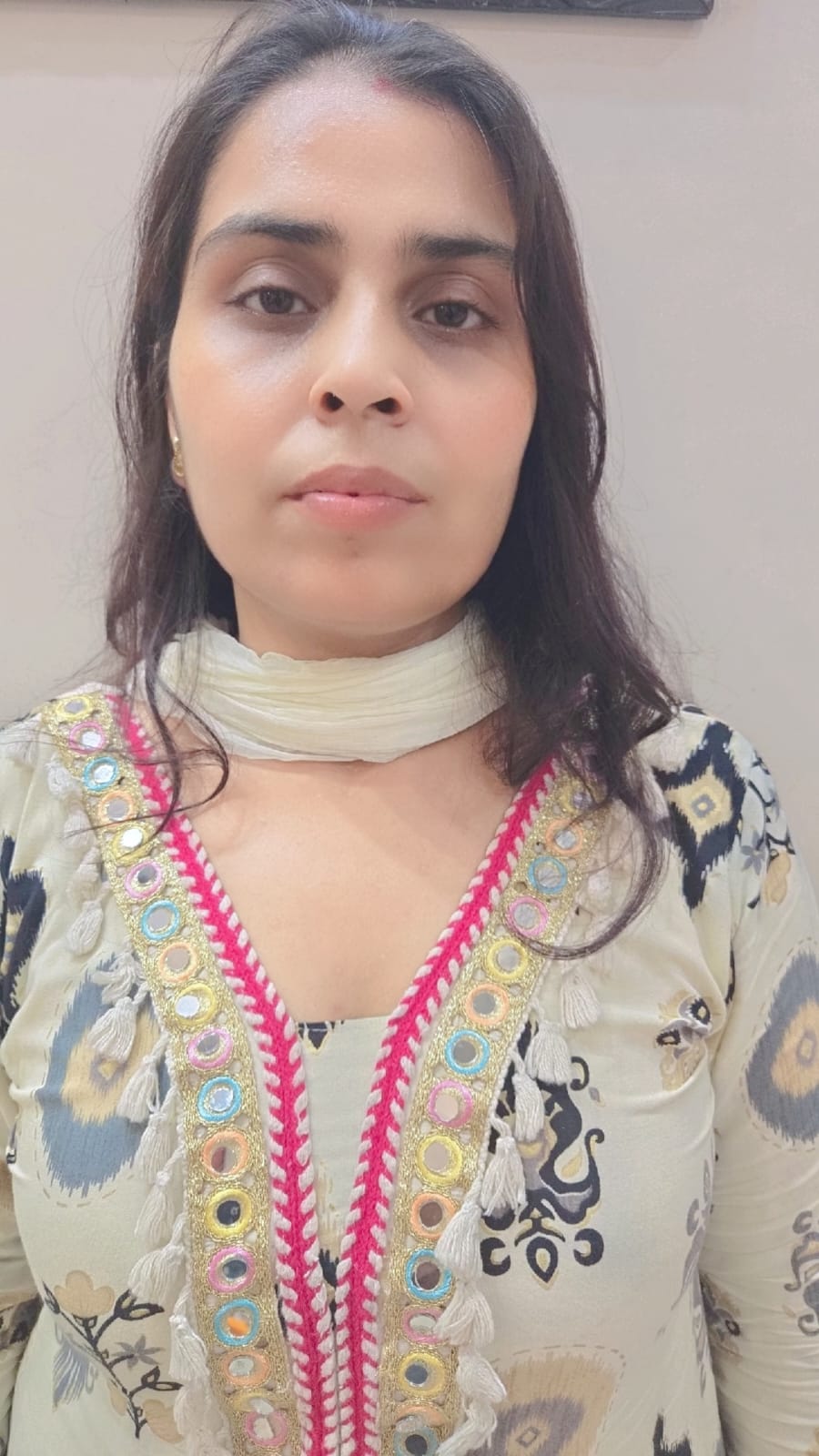
Verified
Jyoti
Mathematics tutor · CBSE · 2 yrs
Ludhiana
- Classes
- 5
- Experience
- 2+ yrs
- Fee
- ₹200/hr

Home and online tutors across Ludhiana, from Sarabha Nagar and Model Town to Dugri, Civil Lines and Jamalpur: CBSE, ICSE, PSEB, Classes 1–12, JEE and NEET. Free demo class.
Pick a class and a subject for tutors in Ludhiana.
Skip — show all tutors in LudhianaReal tutors first, then sample profiles, which are marked
View all tutors →
Mathematics tutor · CBSE · 2 yrs
Ludhiana
Not sure which tutor fits? Tell us the class, board and your sector: we share two or three matched tutors, each with their fee, and the first class is a free demo.
Book a free demo classAcross NXTutors, most home-tuition sessions fall between ₹800 and ₹2,500 an hour; Classes 11–12, IB/IGCSE and JEE/NEET sit toward the upper end; specialists for IB HL or JEE Advanced can charge more. Tutors set their own fee, and you see each tutor's fee before the demo class.
Monthly example: 3 one-hour classes a week ≈ ₹9,600–₹32,500 a month (12–13 classes at ₹800–₹2,500 an hour). An example, not a quote: your tutor's own fee decides the real figure.
| Classes a week | Classes a month | At ₹800 an hour | At ₹2,500 an hour |
|---|---|---|---|
| 2 | 8 | ₹6,400 a month | ₹20,000 a month |
| 3 | 12 | ₹9,600 a month | ₹30,000 a month |
In a coaching batch, one teacher's hour is shared by many students, so each family pays for a part of it. At home the whole hour is your child's: the pace, the questions and the homework check follow one student, and the tutor's travel to your home is part of the working day. A small group of two or three children from the same society usually costs less per child, with less individual attention.
NXT AI can make mistakes. Please verify important details. Continue on WhatsApp
Every Ludhiana page by board, subject and class, home or online.
19 sectors and societies. Open yours for the nearest tutors, subjects and fees.
Ludhiana is a large city by both area and population, and a family hunting for a tutor feels that size straight away. The plotted colonies of the south-west, Sarabha Nagar, BRS Nagar and their neighbours, lean towards Ferozepur Road. Model Town, Dugri and Shimlapuri fill the ground on either side of Pakhowal Road. Civil Lines, the old official quarter beside the main railway station, leads north into Kitchlu Nagar, Rishi Nagar and the Haibowal colonies. Out east, Jamalpur and the numbered sectors stretch along Chandigarh Road and Samrala Road. Children across all of these study for the Punjab board, CBSE or ICSE and ISC, with a smaller group on IB or IGCSE. The tutor who lasts the year is usually the one who lives on your side of the city, knows your board and can keep the same weekday hour.
Everything begins with a single message from you. Mention your child's class and school board, the subjects that feel shaky, your colony or sector plus a turning anyone would recognise, the hours still open once school is over, and whether lessons should happen at home, on a screen or both. Add what you can spend in a month. In return you get two or three suggested tutors, each with a fee you can read before anyone comes to the house. The first class with the tutor you pick is a free demo. Four Ludhiana questions decide who makes that list:
Bring this week's homework to the demo so you see real teaching rather than a performance. When the chemistry is wrong, move to the next name on the list; swapping tutors further down the line is also free.
Tutors you see for Ludhiana come from 1 tutor profile, and 19 Ludhiana localities have their own page. Every one of those pages puts tutors living in the locality first, next come tutors from the wider zone, then the rest of the city, then online tutors from across India. To keep home visits practical we group the city into four zones, starting in the south-west and moving clockwise: Ferozepur Road West, Pakhowal Road and Dugri, Civil Lines and Haibowal and Chandigarh Road East. These are planning groups we made for tutoring, not municipal wards or official divisions.
Sarabha Nagar is one of the main home addresses of south-west Ludhiana. Most families live in independent houses on plotted streets, with builder floors making up much of what is rented, and Pakhowal Road and Rotary Club Road tie it to the rest of the city. Right beside it, BRS Nagar (Bhai Randhir Singh Nagar) follows the same pattern of houses and builder floors, with a few shops inside its blocks. Shaheed Bhagat Singh Nagar, usually shortened to SBS Nagar, sits between the Pakhowal Road and Ferozepur Road sides and is laid out in lettered blocks. Further towards Ferozepur Road, Rajguru Nagar is mostly independent houses and plots, with some builder floors and a smaller number of flats; the office complex of the Greater Ludhiana Area Development Authority (GLADA) stands close to it. To the north, Gurdev Nagar is houses and plots in a central position, bordering Model Town, with Kitchlu Nagar and Haibowal Khurd nearby.
The big change on this side of the city is the elevated highway on Ferozepur Road, built by the National Highways Authority of India from Samrala Chowk outward, whose first span opened to traffic on 11 September 2023, with slip roads at four points. For a tutor coming from the far side it can help; for one coming from the next colony it hardly matters. What matters more is the address. Lanes in these blocks look much alike, so send the block letter, the house number and a nearby turning before the first visit. Pakhowal Road is slow when schools close and again in the evening, so families here often settle on a slot before the rush or a little after it.
Model Town is one of Ludhiana's long-settled residential areas, with houses and builder floors on its inner streets and shops and some offices in its market areas. Next door, Model Gram mixes family-owned houses with flats that are often rented, and sits between the older centre and the southern colonies. Dugri and Urban Estate Dugri began as a village settlement around its old centre and is now inside the municipal area, with the planned urban estate grown up beside it; the area has well-kept parks. Pakhowal Road is both a main road and a residential belt, with flats, houses and builder floors behind a frontage of shops and offices. Shimlapuri and New Shimlapuri are mostly independent houses close to Industrial Area-B, and Miller Ganj is a mixed locality where homes sit among business streets beside Industrial Area-A, Industrial Area-B and Gill Road.
A railway underbridge now carries traffic under the Pakhowal Road crossing, linking the Sarabha Nagar intersection with the canal bridge junction towards Jawaddi. Even so, the road is still busy in the evening, and around the industrial areas the start and end of the working day add to the traffic, so weekend mornings and slots fixed in advance tend to hold up most reliably. On Pakhowal Road itself, give the colony name and side road rather than the road alone. In Shimlapuri some inner lanes are narrow, which makes a tutor on a two-wheeler the easier match.
Civil Lines grew out of the residential and official quarter of the colonial-era encampment and is still a central area where homes sit close to offices and business streets; housing is a mix of flats, houses and builder floors. Ludhiana Junction, opened in 1864 with seven platforms, stands in the old city area next door and serves lines towards Ambala and Attari, Fazilka, Jakhal and Chandigarh. To the north-west, Kitchlu Nagar is mainly independent houses, with New Kitchlu Nagar beside it and Hambran Road close by. Rishi Nagar leans more towards flats and builder floors, with some large houses. Haibowal Kalan, with Haibowal Khurd alongside, is largely independent houses spread across several colonies with similar names. Further north, Salem Tabri, towards the Jalandhar Bypass side of the city, is mostly flats and smaller homes, many of them rented.
Being central, this zone is the easiest one for tutors to reach from several directions, and a tutor who travels in by train can finish the trip from Ludhiana Junction by auto. The trade-off is evening crowding around the station and the old city, and through traffic on the roads leading to the Jalandhar Bypass, so a slot soon after school usually works better than a late one. In the Haibowal and Salem Tabri colonies, always give the colony name with the house number, and in Kitchlu Nagar say whether you mean the old or the new part.
East Ludhiana is where the numbered sectors are. Sector 32A is a planned sector on Samrala Road, with parks spread through its layout and commercial pockets serving the homes, and GLADA notices refer to it as one of its planned sectors. Sector 39, with Sector 39A beside it, lies off Chandigarh Road and mixes houses, plots, flats and builder floors with shops and offices in its commercial pockets. Jamalpur and Jamalpur Colony line the Ludhiana-Chandigarh Road close to these sectors and to the Focal Point industrial area, with varied housing from houses and floors to flats and plots.
Sector numbering makes the first visit simple: the sector, block and house number are nearly always enough. The harder part is timing. Chandigarh Road and the roads around Focal Point carry industrial and through traffic, so weekday evening slots need some margin, and many families here use weekend mornings for the longer lesson. Dhandari Kalan station sits beside National Highway 44 on the line towards Ambala, between Sahnewal and Ludhiana Junction, and the rail link from Ludhiana to Chandigarh was inaugurated in 2013. Ludhiana Airport is out at Sahnewal on this eastern side.
Most Ludhiana pupils sit papers set by the Punjab School Education Board, by CBSE, or by CISCE (ICSE, then ISC); fewer are on IB or Cambridge IGCSE. A tutor who knows one board well can still be a poor fit for another, so we look at board and class as one requirement, never the subject on its own.
PSEB was created by a legislative enactment in November 1969 to develop and promote school education in Punjab, and an amendment to its Act in 1987 made it autonomous. It is headquartered at Vidya Bhawan, Phase-8, SAS Nagar (Mohali). Its work includes affiliating schools and compiling, publishing and selling textbooks, so a PSEB tutor should teach from the board's own books. Its certificates for Classes 8, 10 and 12 are available on DigiLocker. For paper formats and dates, rely only on pseb.ac.in. See our page on Punjab board tutors in Ludhiana.
CBSE builds its papers on the NCERT books and keeps adding questions that ask a student to use an idea in a setting they have not seen before. That suits a teenager who is also aiming at JEE or NEET, because thorough NCERT work feeds both. Where such students often slip is the written board answer: complete steps, units and explanation after months of ticking options.
The Class 10 ICSE and Class 12 ISC papers ask for lengthy written answers over a wide course, and English includes prescribed literature. Expect a sound tutor to revise in repeated rounds, time written answers and keep an eye on project and practical work, which tends to slide when term gets busy.
Students on the IB Diploma or Cambridge IGCSE frequently find their specialist online. IB counts coursework as well as exams, and while a tutor can guide the thinking behind an Internal Assessment or Extended Essay, the work must stay the student's own. IGCSE preparation leans on old papers checked against Cambridge's mark schemes.
In primary and middle school the goals are plain: confident reading, reliable arithmetic and written work that is finished and tidy. Where Punjabi or Hindi is spoken at home and the school books are in English, short spells of reading out loud in every session help a great deal. Ahead of any early foundation course, make sure the Maths of the middle-school years really is solid, since later work is built on it.
Maths and Science step up sharply in Class 9, often in the same year a student signs up for extra classes. The tutor's task is to stop the school course falling behind so the board year that follows has room to breathe. CBSE families can hand the tutor our Class 10 Maths roadmap and chapter notes for Class 10 Science follow the NCERT order and are worth sharing with the tutor.
The jump into Class 11 is the biggest of the school years, with fresh topics coming fast and a large share of the entrance course packed into them. Weak foundations from that year in Physics or Maths seldom get repaired during Class 12, so a subject specialist for each difficult paper is better than one tutor for everything. Our Class 12 Physics study strategies cover the board year.
Once students reach Class 9, most requests are for Maths, Physics, Chemistry and Biology. Beyond those four, tutors on NXTutors cover English, Punjabi, Hindi, Social Science, Computer Science and the commerce papers (Accountancy, Economics, Business Studies), and many handle all subjects for the junior classes. Commerce students in Classes 11 and 12 often want accounts help alongside Maths. Each of the core subjects has its own Ludhiana page: Maths tutors in Ludhiana, Science tutors for school classes, Physics tutors and Chemistry tutors.
Maths help works when the tutor traces a mistake to the year it started and repairs it there. Physics improves when every formula is explained from the idea behind it. Chemistry splits three ways, with calculation drills for Physical, reaction logic for Organic and attentive reading for Inorganic, as set out in our note on Organic and Inorganic Chemistry for Class 12. A student moving from a Punjabi- or Hindi-medium school into English-medium textbooks needs a tutor who explains technical words in both languages at first and then steps back; for speaking practice between lessons, try our guide to spoken English for students.
Yes. For most Ludhiana students it means working alongside school and any coaching they already attend, not replacing it. A tutor earns their place by taking on a clear role:
JEE Main is conducted by NTA twice in the early months of each year, and qualifying in it opens the way to JEE Advanced. NEET UG comes once a year and half its marks are Biology, which is why close reading of the NCERT Biology text is worth the effort. Dates should come from the official bulletin for that year alone. Our chapter-wise plans for JEE Maths, JEE Physics and JEE Chemistry, plus our NCERT-first method for NEET Biology, give a tutor a ready framework to follow. Our article weighing coaching against a home tutor for JEE was written with Gurugram in mind, but the questions it asks apply just as well here. For local tutors see JEE home tutors and NEET home tutors in Ludhiana.
Sitting at the same table helps small children, teenagers whose attention wanders online, and subjects where you need to watch the working on paper, such as Maths or Physics numericals. Lessons over video bring in specialists from other cities, a real gain for IB, IGCSE, rarer ISC electives and harder entrance problems. In Ludhiana, a few local points tilt the decision:
A common pattern is a couple of home visits each week plus a brief online catch-up in the run-up to a test, with one tutor doing both. The trade-offs are weighed in our home versus online tutor article, and our page on online tutors for Ludhiana students covers the online side.
Across NXTutors, most home-tuition sessions fall between ₹800 and ₹2,500 an hour; Classes 11–12, IB/IGCSE and JEE/NEET sit toward the upper end; specialists for IB HL or JEE Advanced can charge more. Fees are set by each tutor and shown to you ahead of the demo. If two quotes differ, the reason is usually one of these:
Spend most on the subject that is hardest for your child; one capable tutor there tends to achieve more than thinner help in several subjects. Questions worth asking before the demo are how long a lesson runs, how missed lessons are handled and whether homework is checked between visits. The pricing guide explains how fees vary, and our article on home tuition fees in Ludhiana looks at the local picture.
The profile is what earns a tutor a place on your list. The demo hour is where you decide. Notice whether:
If you live in a flat, pass the tutor's name to the guard in advance; for a house, share the number, the colony or block and a location pin. Lessons belong in a common room while a grown-up is home. More help is in our checklist for the demo class and our article on picking a board and a stream.
CBSE's session starts in April, and a typical Ludhiana board or entrance year falls into five stretches:
Treat official notices as the only source for dates. An April start buys the whole year; joining mid-year is still worthwhile, with the emphasis shifting to past papers and answering technique.
Share the class, board and subjects, your colony or sector and a landmark, and the free hours in your child's week. Two or three tutors come back as suggestions; one of them teaches a free demo, and only then do you decide. Start with your own locality in the list on this page, look through every tutor, or go straight to a free demo class. Where nobody nearby teaches at home yet, an online tutor based elsewhere in India can begin at once.
Our Ludhiana home tuition guide walks through all four zones, from Sarabha Nagar and Dugri to Haibowal and the Chandigarh Road sectors, locality by locality.
Looking elsewhere in the region? See home tutors in Chandigarh, Amritsar, Shimla and Jammu, or cities across India.
Tutor yourself? Home tuition jobs in Ludhiana shows which colonies and sectors have families asking for help.
Tutors set their own fees, by class, subject and experience. Across NXTutors, most home-tuition sessions fall between ₹800 and ₹2,500 an hour; Classes 11–12, IB/IGCSE and JEE/NEET sit toward the upper end; specialists for IB HL or JEE Advanced can charge more. You see each tutor's fee before the demo class.
Tutors currently cover 19 areas of Ludhiana, including BRS Nagar (Bhai Randhir Singh Nagar), Civil Lines, Dugri and Urban Estate Dugri, Gurdev Nagar, Haibowal Kalan. Each area page lists the tutors nearest to it.
CBSE, ICSE and ISC, IB and IGCSE for Classes 6 to 12, plus JEE and NEET preparation, at home or online.
Yes. The first session is a free demo class, so you can judge the tutor's teaching style before deciding. If the fit is not right, we suggest another tutor.